Friday, August 24, 2012

Red Whines: It's Not About the Bike Anymore

Funny enough, I think he wrote a book with almost the same exact title several years ago...

Over the course of several years, biking legend Lance Armstrong has fought through many hardships in life. Famously, he had overcome cancer and began his Livestrong movement to raise money for cancer research following his bout with the illness.  Following his cancer battle, he had competed in numerous events and won many international biking titles, including seven consecutive Tour de France titles. Some people could say he is the most influential athlete in the world...until the U.S. Anti-Doping Agency comes along.

You may be familiar with this Agency. These are the guys that administer a drug test whenever there's an international event just to make sure that you don't decide to take a banned substance during that time period. Numerous athletes and cyclists during the 2000's had allegedly (keep this word in mind) stated that Armstrong had doped on several occasions. Many of the blood and urine samples that Armstrong had apparently given to officials were stored and later tested for additional performance-enhancing drugs. Finally, Armstrong was charged with drug trafficking (what?) and doping during 2009 and 2010. Because there has been so much of a fight between the USADA and Lance Armstrong, suspensions were handed down, banning Armstrong from competition in cycling and triathlons.

Following the numerous throwing out of lawsuits filed by Armstrong over the past year, he had decided to end his fight against the USADA while maintaining innocence on Thursday.
Their response:
Lance Armstrong will been banned from cycling for life. Also, his seven Tour de France titles will be stripped from him.

Although the USADA would have to state their case to the International Cycling Union (UCI) on Friday, this sentence is the most unprecedented sentencing in cycling history. 


Commence worldwide uproar.

It's understandable that there are allegations behind Lance Armstrong and how he was in such great physical form when he was. For example, it's incredible how he managed to win a Tour de France title in 1999 when he was declared in remission just a year prior to that. Sure, he was one of the best cyclists in the country before his cancer diagnosis after the 1996 Atlanta Games, but I guess there are just some Negative Nancy's out there that believe that his comeback was practically superhuman.

The USADA's response to Armstrong's ending of his court battle was treacherous. In Lance's case, he didn't stop fighting because he knew he was guilty and didn't want to fight a losing battle; he stopped fighting because it was incredibly one-sided (from what I've read) and nobody is willing to accept his claims or the lawsuits that he had filed in the past year.

From ESPN.com:
"USADA reacted quickly and treated Armstrong's decision as an admission of guilt, hanging the label of drug cheat on an athlete who was a hero to thousands for overcoming life-threatening testicular cancer and for his foundation's support for cancer research." 

My thoughts exactly. It's truly as if they had eliminated the whole "innocent until proven guilty" thing and just added a "guilty until proven innocent, and you're not allowed to defend your case" because of the turmoil that he, his family, and everyone else around him was going through.

From the same article:
"Foundation chairman Jeffery C. Garvey issued a statement, saying, 'Faced with a biased process whose outcome seems predetermined, Lance chose to put his family and his foundation first. The leadership of the Lance Armstrong Foundation remain incredibly proud of our founder's achievements, both on and off the bike.'"

Of course, there are other people that state otherwise...

From CyclingNews.com: 
Kathy LeMond (wife of Greg LeMond, Tour winner 1986, 1989, 1990): "Finally."


Oh, and that's not cold of you to say. You were obviously there when he did something.

Apparently, the USADA had other evidence against Armstrong that would certainly bury him, but because of his decline to fight any longer, this evidence may not see the light of day until, of course, when the man dies or something like that. When you think about it, it's like the USADA was like, "OOH! OOH! Look at what we found," and they didn't want any outside rebuttal in fear that their evidence might be tarnished. However, if they do want to state their case with the UCI, some of this will have to be released.

There are probably people out there that would say that an innocent man would fight this case against the USADA to the grave. However, what Lance did might have been the right thing. In one case, arguing about false allegations would be interesting psychology in making an accused person seem more guilty. Bickering about something in such detail could actually cause more allegations to be made toward one's performance-enhancing measures. If he talks any more, things he would say could be greatly taken out of context and could still be used against him.
Secondly, this whole case could go over the course of several months to possibly a few years because not only would he be in the spotlight, but there could also be a chance that other cyclists and athletes could be thrown into the mix to either testify or be accused themselves. Because our court system likes to take forever with even the biggest of federal and international cases, he wouldn't want to put his family and friends through more painstaking turmoil.
Thirdly, he could possibly be accused for medical practices that were strictly used for cancer treatment over 15 years ago. Think about it: they're considering him guilty due to illegal doping by way of blood transfusion. The first thing that comes to mind is that even though he's in remission, some of the treatment he received is wrecking his body in the fitness aspect and he actually needs some of the treatment to remain healthy. I may not be a doctor, but why haven't the USADA talked to Armstrong's specialists?

From what I have seen, it seems like self-defense and any other form of fighting against a juggernaut of an agency takes away freedom. Lance fought the law, but I don't think the law will win the way they want to. This truly isn't about the bike anymore. It's about his family and his dignity.

--AZ

(Referenced articles from: 1, 2)

Tuesday, August 21, 2012

Athletes Can Write Too. Apparently.

I picked this topic up about a day ago. A lot of you might have heard that U.S. goalkeeper Hope Solo has just recently released a book about her life, struggles, career, and some of the dirt she has had to put up with in the world of sports. Yesterday, it was announced that U.S. striker Alex Morgan just got a book deal, not to write a story about herself, but a three-book series directed to teenage girls about friendship, values, and soccer.

Gee, they all write now, don't they? That's not necessarily a bad thing.
________________________________________________

Excuse me while I step into my childhood for a minute.


Books are cool things. I often hated to read them, but when it became absolutely necessary to do so in high school, I had to start finding things I liked in order to peak my interest in reading. Three guesses and the first two don't count on what kinds of books I like to read. The answers are sports and the media, in case if you were stumped.

The first book of the sports-genre I read and liked. Supposedly there could be a movie about this in the near future.
It's a usual thing for big-name celebrities and athletes to write about their lives (sometimes with the help of another author). Heck, they might even write more than one book during their time. You expect a lot of retired people to do this, especially if it was public knowledge that there were problems (i.e. drugs, alcohol, abuse) during one's career. Texas Rangers outfielder Josh Hamilton and Philadelphia Eagles quarterback Michael Vick are examples of some of the athletes going that route. Some may even write about the hardships they have overcome to get to where they wanted to be. Recently, retired pitcher Jim Abbott released a book called Imperfect: An Improbable Life talking about his disability--he was basically born with only one full hand--and how he beat the odds by making it to the majors and eventually throwing a no-hitter in 1993 against the Cleveland Indians. In my opinion, books like that will sell very easily. In a case such as Michael Vick's, the controversy surrounding him was huge. After the dog-fighting ring and his court case and his sentencing, he just pulled a 180 and came back to football. PETA still might not like him, but he's regrown his fan base and has gained respect from people due to his turnaround. In Jim Abbott's case, he's giving the chance for young people to take a look inside of them and see themselves as something special instead of something imperfect. [Side Note: I've found out that many schools around the country have his book on their summer reading list this year.] In reality, Abbott himself is a motivational speaker, and his book is a way to reach the other people that might not have heard him talk before.

You see, those uses of [auto]biographies are efficient and excellent tools of sending out a message to readers. There are other ones that are quite questionable and not so cool when it comes to sending a message. Most may have the values thrown in there, but there may also be a monkey wrench slathered in controversy thrown in there too.

There have been books released over the past ten years that included the athlete's problems and automatically pointed fingers and going "this is why I'm like this" or "I was never at fault." It's almost as if athletes are writing the books as the be-all-end-all "stop picking on me because you know the truth now" deal. I'm serious. It feels like it's the "ultimate response" to the media since the athlete's book leaves little room for interpretation. Here's looking at you again, Jose Canseco. Ooh! Here's another example:
O.J. Simpson's book...You HAD to see this one coming.
I'm not knocking the whole idea of athletes writing a book about their lives, but it should be done responsibly; it shouldn't be done to make a statement about something or to end your side of the argument with a "SO THERE!" of sorts. I'm not the biggest fan of athletes that know they'll make money out of dirt they've experienced because people will want to read the truth about controversies that they've experienced. It's a dirty marketing tactic that works because the media will pick it up and will lead to more money on that athlete's end. That's almost like saying I'm going to write a book on how I allegedly saw some hockey players pushing pills at a bar one night and expect to get exposure out of it. [Note: This was an example. This never happened.] These guys who release dirt like this give the other athletes a bad name that with good intentions of releasing a good autobiography.

Are you guys fans of these books? Do you even read at all? I'm curious.
Comment and continue the talk. I've said my piece..what are your thoughts?

--AZ

Sunday, August 12, 2012

AZ's Slant on Sunday - For the Country, or for the Paycheck


For athletes all around the world, being in the Olympics is kind of a big deal. Winning any kind of medal could deem you a national hero. First time medalists like Grenada's Kirani James will forever be recognized in the history of the country as the first countryman to win a medal (a gold medal at that) for the country. Other perks come along with winning a medal too. For example, Kenyans make their medalists official "lion hunters" of their tribe, which I think is pretty awesome, considering that their culture still stands today amid the crazy advances in technology and culture. Also, in South Korea, the bronze medal soccer team is exempt from mandatory military service for a whole year (story here). Being an Olympic athlete can also be a gateway to something more personal if the athlete is successful. Australian diver and 2008 Olympic gold medalist Matthew Mitcham came out as being openly gay and inspired gay people and athletes worldwide.

Stuff like endorsements in larger-scale countries may be cool too, but hearing the foreign culture perks is some powerful stuff. Smaller countries take these things so much more seriously than others may let on. In the United States, some people might actually take their status for granted. They might...actually want to get paid for doing this.
The 1992 Dream Team was better as far not complaining, that's for sure.

Current Miami Heat player Ray Allen was rather vocal about this a couple of months ago, stating that since NBA players are practically walking-talking-advertisements, they should get their own sort of "royalties" for taking part in the Olympic Games. Dwayne Wade agreed with this, saying it would be "fitting for the players to be compensated" since they only have two weeks of rest until the NBA rush starts. Kobe Bryant wouldn't mind this, but he'd still play anyway.

Per NBCSports' Kurt Helin:
“[Allen states:] Everybody says, ‘Play for your country.’ But (NBA players are) commodities, your businesses. You think about it, you do camps in the summer, you have various opportunities to make money. When you go overseas and play basketball, you lose those opportunities, what you may make… If I’m an accountant and I get outsourced by my firm, I’m going to make some money somewhere else.”

Helin then responds by saying: 
"I think Allen misses the mark here because there is a huge financial incentive for the top guys — it’s about international brands and shoe sales. Allen is spot on with his premise that NBA players are commodities in the eyes of teams, but they are also their own brand if a guy is a smart businessman."

Somebody gets it.

I remember watching women's diving a few nights ago and Pandelela Rinong, a young woman from Malaysia, became the first female to win a medal (a bronze) at the Games. She said during her post-event interview on NBC that she was "proud to be a Malaysian." Isn't that enough to feel that happiness inside for her? Even during the preliminaries for track and field, the announcers were saying that a lot of the competitors (most were from super tiny Pacific islands and small African countries) were just happy that they made it to the Olympic Games to represent their country. And then...we have some guys that think they're too big for their own britches and think that representing their country isn't enough. It's as if there are some people out there in the U.S. that don't appreciate what the Olympic Games are all about. They think it's another opportunity for exposure and a bonus. Sure, you will hear other American athletes saying how proud they are of their heritage and say that the United States is the greatest country in the world. You don't really hear the verbal diarrhea like Allen's statement coming out of their mouths like that. It's ridiculous, in my opinion. Whatever happened to patriotism?

When you are an Olympic athlete, you share the same stage with the greatest athletes from other countries. Some of these countries are so poor that they had to work something out with the IOC and find a way to get their athletes to London this year. Heck, some people were actually "independents" that couldn't get endorsements from their host country or their country is in such peril that they "seceded" in a sense in order to compete. There are so many unfortunate people out there and their Olympic-caliber talent is all they may have. These people might not even get paid at all; some medalists actually owe money (hello, Missy Franklin!) because their medals are worth something and they may have to pay taxes on the thing. 
[Thinking about that, I wonder how much Michael Phelps has had to pay over the past eight years...]

(Credit to Bleacher Report)
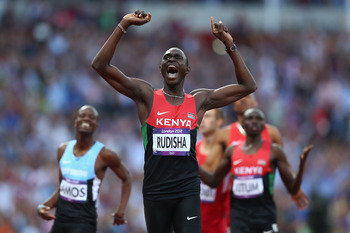
Just look at Kenya's David Rudisha. Do you think he's thinking about  his world record run or why he's not getting a fat sum from this?

As far as money goes, WHAT MONEY? You might not get the profit you think you deserve, but aren't you getting your foot in the door for bigger bonuses to come? Speaking about getting money outright from the Olympics itself couldn't be any more boneheaded. I was always taught to "think outside the box," and it sounds like there are some athletes out there that have agents that think for them and those athletes couldn't even negotiate their way out of a box to begin with. Just as Kurt Helin mentions in his story, you're a professional athlete playing in a professional sports league. That most likely means you know how the business works; it's absolutely difficult to play in a league and not know what's going on financially around the league or what have you. I'm pretty sure you know how to be a good businessman and make the most of what you have. There's no reason to go knocking on the IOC's door asking where your paycheck is. You have the exposure now--get the endorsement deals. That's going to give you the money you want. 

It's an honor to play in the Olympics. It's not an entitlement, nor is it a multi-million dollar deal, and it isn't something that should be treated like a standard sports practice. An international competition like the Olympics is so much grander than that. Coming from a large country like the United States, I guess that could be difficult to fathom since we may have a better set-up for most sporting events and every sports final is a big deal in the country. But getting the recognition from smaller countries on a big stage like this should be enough. In the Olympic Games, t's about the love and passion, not the money. This year's Olympic motto was "Inspire a Generation." You're in no way "inspiring" if you're sounding whiny because you're not making money like you think you should. Again, this is an honor and not a choice here.

Do it for the country, not for the paycheck. You're proving to the world that you come from the greatest country of all and you're proud of where you came from.

Mr. Allen, if you want more money, go ask Spike Lee to make He Got Game 2: The Big Time.

--AZ

(Sources of today's tirade: 1, 2)

Thursday, August 9, 2012

Women's Soccer Debacle: Join or Die (Literally)

If you guys have been living under a rock for the past few hours, a lot of you may have witness or have found out that the U.S. Women's Soccer Team beat Team Japan 2-1 in the Gold Medal Match at the Olympics. After losing in the 2011 Women's World Cup in a shootout, the American ladies struck back and claimed the top prize. I guess you can say they struck gold. Tee hee.

Due to the stunning popularity of these girls over the past two weeks, there are talks to keep these girls in the public eye and continue pushing women's soccer in the United States. Basically, they're pushing for another professional women's soccer league to rise from the ashes of the fallen American leagues in Spring of 2013.

Oh, here we go again...

Truth be told, there actually are women's leagues in the United States, but they're not that well-known at all. The two leagues that cover the United States (and also Puerto Rico and Canada) are the USL W-League and the Women's Premier Soccer League. Due to the folding of the previous professional leagues in the U.S., the WPSL has benefited a great deal from this, as they have adopted some of the folded teams and the deals that were ensured from sponsorships. The W-League has also gained strength in receiving help from the bigger MLS teams and got some exposure from Universities since the league is considered an open league. Cool, right? Well, apparently it's not enough and people want a standalone league.

It's understandable that the country wants to feed off of the successes of the national team, but didn't we all go through this before? Let's take a walk through the U.S. Women's Soccer League Graveyard...

#1 - WUSA
Founded: 2000
Folded: 2003

This league was rooted in the U.S. Women's successes in the 1999 Women's World Cup. After defeating China in a penalty shootout (leading to this perennial image), girls soccer was a hot topic at the turn of the century. Personally, this World Cup actually spiked my own interest in soccer, leading me to stick with playing competitively for another seven years. Nationally-known players like Mia Hamm, Tiffeny Milbrett, Briana Scurry, and young Abby Wambach and Hope Solo were participants in the league, bringing droves of screaming young girls and youth soccer teams to games. However, the case of this league, they almost got a little too big for their britches and fell into serious debt due to their budgets going overboard. Attendances and ratings started faltering after the first regular season, and the women starting suffering pay cuts. The league folded shortly after the 2003 season, before the Athens games commenced in 2004.

#2 - WPS
Founded: 2007
Folded: 2012

After the WUSA folded in 2003, a lot of the previous team owners and admins of the league were looking to reinvent the wheel and start another league while avoiding all of the issues they completely Mexican hat-danced in the first time around. Although the league was founded in 2007, they were trying to avoid any operation until the 2007 Women's World Cup ceased and the 2008 Beijing games ended. Once that was over, they had announced numerous national players coming to the United States to play among several teams (some returning from the WUSA days). The first season was rough, leading to two sudden folds from financial problems, and later seeing the team name Washington Freedom changed to magicJack. [I'm dead serious. The guy who owned the team owned the magicJack company and made that the team name. Why? I don't know.] In the third and final season, there was a massive upsurge in the league with thanks to coverage from the 2011 Women's World Cup, and there were hopes of gaining more teams and revenue in time for the 2012 season. However, that didn't happen, and because of the problems that stemmed from ongoing financial shortcomings, the league suspended operations and later folded earlier this year.

Per ESPN:
"Michael Stoller, managing partner of the Breakers, said in the statement. 'We want to emphasize this is not a competitor to any of the existing leagues, but rather this is a significant step up in the competitive level and professional standards, and we expect to establish a natural relationship to allow teams to enter this new league and perhaps to fall back (self-relegate) to their prior league if they need a break from the higher spending and competitive requirements.'"

The owners that are adamant in creating a new league is using other leagues' salaries as an argument. Wait, isn't money what got you guys in trouble in the first place? If you want to get the international players like Marta and Cristianne, you have to make sure you have the goods and services to keep them there and keep the rest of the team intact. Their hearts are in the right place, but if they really want to get a league that stands on it's own two feet, it needs to lean on a brother for a little while until the training wheels come off. I'm looking at MLS here. In the near-20 years that MLS has been around, they've suffered through a lot of problems, and now they've become the third-most attended sporting event in the United States (behind MLB and the NFL, of course). Seriously, if you can't beat 'em, join 'em.

The one thing they mentioned was relegating back to their previous leagues. In other words, they're opening this to the forum, in this case the W-League and the WPSL. Although they might be smart businessmen, they need to make better business deals and better networking outlets if anything is going to be stable and work for over three seasons. Some of the teams in the league already get help from MLS by name usage. I'm hinting this here, businessmen of the American soccerlands. This could be useful. I didn't study public relations for four years to talk utter nonsense about business deals and communication/marketing. The United States Soccer Federation (USSF) seems to be all in with this, considering how there hasn't been a flagship league for women that has lasted for more than three playing seasons. They're riding on moments like Alex Morgan's extra time goal against Canada in the Olympics as moments where girls (and boys) want to see these things close to home.

Unfortunately, I have a bad feeling about all of this. They have very high hopes for getting this off the ground in time for Spring 2013, and because of the rather poor track record of these guys over the past 14 years, things just seem rather fishy. Sometimes even the highest of confidence marks the highest fears. All corners need to be boarded and watched for any impending storms that may approach if another women's professional league is founded. If there's one false step, the credibility of U.S. Women's Soccer could tank really easily and really fast. In conclusion, they better find someone to lean on in case things get nasty. For the future women's pro league, it's not sink or swim, it's join or die.

(Much thanks to AP and ESPN for these two articles: 1, 2)

Tuesday, August 7, 2012

Inflation: It's Not Just for Money Anymore

During the Olympic Games, you will see the best of the best from each country. You will see the results of blood, sweat, and tears. You may also see history made in the form of new records, whether they are Olympic records or World records. If you have been watching the Olympics for the past week and a half, you've noticed that a lot of records have been shattered during these games; some of the records that were set during the games were shattered again later in the games (Rebecca Soni's breaststroke, for example). With these instances becoming more frequent, what is the kind of inflation going on in the world of sports?

We can't blame it on doping...right?
Here's looking at you, Marion Jones.
Don't get me wrong, athletes are allowed to push the envelope, but good gravy--what do they eat? What do they do to be able to inspire and influence a world by setting a time or a score that can be immortalized?


In today's day and age, we are suffering from the ultimate inflation of athleticism. There may be records that haven't been broken in over 20 years, but there are records being broken on a consistent basis; records that may only stand for a year or two. There are definitely records that are impressive due to the natural talent being displayed (Usain Bolt), and there are records that are going to stand from long-standing determination (Michael Phelps' 22 medals since 2004). However, what about the other things? Will there be something for the younger ones to believably chase?

I'm sure that there will be. In a major age such as this, we have the tools and abilities to help enhance the talents and abilities of the children asking for help and for the capability to do the things they see on television or on the Internet. These athletes have the heart and soul that are required to work at the rate their coaches expect of them. Cooperation between athlete and coach are key in making the impossible actually become possible.

You could say that the standards of training have been pushed skyward, as coaches are being more stringent on training and everyday practices, and the athletes themselves are living and breathing their sport so much more than before. Grant it, these things pay off, but is it natural to be this good and to be breaking records this easily? What are we leaving for the children that are future swimmers or runners? That's an easy question to answer--a smaller margin of for error that separates the athletes from the hobbyists.

Katie Ledecky is practically a child and now a gold medalist...and it makes me feel incredibly old and flabby.
There is no denying that this is an epic age for sports. There doesn't seem to be any room in the sky for the numerous amounts of talent breaking records and making history. I'm scared of it, but in a good way. Just think, with the impressive displays of athletes, we could actually see something like a 100-meter dash done in eight seconds. Age could be a factor too; we witnessed 15-year old Katie Ledecky break the Olympic record for the 800-meter freestyle, and it could only get better for a young girl like her. Believe me, it gets better for these people, but it gets scarier for the people striving for greatness. In order to be the best, you have to match something like that. The human body is an impressive thing, so I'm pretty sure that this "inflation" thing shouldn't be a big deal for the children and teenagers looking for the ultimate prize of being called a champion.

--AZ

Friday, July 27, 2012

...Do I Hear Tympani? RUN...to Your TVs!

That must mean one thing...That this is...
An Olympic-sized introduction.

YEAAAAAAAAAAAAAAAAAAAAAAAAAAAAAAAAH

Alrighty, folks, we've made it to the point in time where there's a two-week stretch in which you can't say there is nothing to watch on TV. Today, the opening ceremonies for the 2012 Summer Olympic Games in London will commence, and thousands of competitors from numerous countries will proudly represent their respective homelands and compete for the ultimate prize of being named the best in their sport.

If you've been keeping track with Olympic coverage, some events have begun even before the opening ceremonies based on the massive involvement of it by many teams (It's soccer and archery, if you haven't been keeping track). Some may actually go simultaneously with the opening ceremonies (which is awkward, if you ask me). If this is all that will be playing in your household for the next two weeks, you may actually watch things that you never considered to be sports in your life. I'm talking about shooting, fencing, handball, equestrian, wrestling, and other various things they put on in the late hours. The more popular sports that people watch here in the United States are women's soccer (not the men), swimming, and gymnastics. I'll admit, it will be rather awkward not seeing Olympic softball and baseball on my television this season, but there are bound to be other interesting sports to watch. People like Ryan Lochte and Michael Phelps will be all over television sets, and people will be squealing all over Facebook and Twitter over the big athletes that will become legends during these Olympic games.

Grant it, you might feel like a total dope if you get caught watching something like water polo or mixed doubles badminton, but it's kind of interesting on how much you become engaged in a sport you may have never watched before. For example, I was absolutely sick off my bum during the 2004 Olympics in Athens, and while I was laying on the couch one morning, I was watching mixed doubles badminton between China and Great Britain. That was probably the most exciting thing I had ever watched. Sure I was sick, but oh man, that was cool. Table tennis came on after that. Words can't express the feelings on that one. I'm not even being sarcastic either. At any rate, your mind can be opened when you watch the Olympics. I know someone who is now a big curling fan with thanks to the Winter Olympics. I will admit, I did get into handball for a little while, but who the heck plays that in the United States? Anyway, oh man, these events are hypnotizing.

In the cases of national news coverage, a lot of the hubbub involves David Beckham, a British native and world-known soccer player, who is allegedly "doing something special" during the opening ceremony. My brain says: "Him? I'm more interested in seeing his wife reuniting with the Spice Girls, for crying out loud." In reality, I'm excited for him. Obviously there's no glass ceiling for him, and he's a good sports poster child for doing anything in representing Great Britain. It should be a fun kick-off to the next two weeks of sports. Except...I really don't feel like hearing this as the theme song for the next two weeks. It's Muse's attempt to be Queen and it's absolutely horrible.

The Olympic games are unpredictable and have many exciting twists and turns. I'll admit I'm looking forward to it.

--AZ

Sunday, July 22, 2012

Red Whines: Is Penn State Deserving of a Large Punishment?

(RIP @JessicaRedfield)

There hasn't been a bigger sports story over the past nine months than the Jerry Sandusky/Penn State scandal. Numerous people have kept up with the trial, the aftermath at Penn State, the Freeh Report, and the question of the future of the Penn State athletic program. According to the Freeh Report, there were indications among the administration that Sandusky was performing lewd acts and nobody did anything about it. Considering how this stuff had been occurring over a 10+ year period (possibly longer), this is seen to be a massive faux pas by every big name that worked at the University in that time period.

You know what this means...
Joe Paterno has left the campus.

Joe Paterno is now known as the biggest load of taboo in the college sports world. People are demanding that the statue erected in his honor out in State College be removed due to the unveiling of all of the underground work to cover up Sandusky's low-brow tendencies. It was like they were trying to get away with murder or something and then someone just happened to say something about it 20 years later. What I think is not only were they believing in the "out of sight, out of mind" deal, but they were also thinking that it was some sort of phase and if they'd ignore it, it would cease. Obviously, that didn't work.

Today, critics are suggesting that due to the infractions committed by Penn State's administration and athletic programs, they should be given the "feared" Death Penalty by the NCAA. Others are considering loss of broadcast games or loss of scholarship opportunities. The Penn State community will be finding out their fate during a NCAA conference in the morning. I wrote about the Death Penalty before, and just by reading how other people got this killer of a penalty, you can clearly see why I am writing about this: Punishment from the NCAA makes NO SENSE in a scandal like this.

Don't worry. There's a method to my madness in saying this.

Here are the reasons:

Almost everyone from PSU's administration has stepped down amid the controversy. Ever since Graham Spainer and Joe Paterno were fired from their positions at Penn State, almost everyone involved or associated with it followed suit and resigned. Trust me, it was pretty obvious they all knew something, but do you think they would be stupid enough to tell the players of their involvement in the scandal? Out of fear, they chickened out and jumped ship. Especially in a new era where there are more than enough officials innocent of this, I don't think they deserve something that a couple of idiots hid from 10-15 years ago. However, if there is anyone still there, I'm pretty sure something should at least apply to them.

Secondly, there should be no reason to punish the football players that had no say or action in this just because of association. If I were a sophomore defensive tackle or whatever, I would be rather upset because I wasn't involved in the sex abuse scandal. I don't actually doubt that the players didn't know anything during their football years at PSU, but for the incoming guys certainly had no clue especially after Sandusky's retirement in 1999.

Thirdly, this is clearly an internal matter within the University, the coaching staff, and the administration. There's no need to shut down a football program because a rotten apple went and spoiled the bunch. Sure, we're dealing with a guy who has committed numerous sex crimes among young boys and even more people covered it up for over a decade. However, I don't think the NCAA should intervene in ways of punishment for judgments of people who are no longer in power at the University.

This is a rather sticky situation that I think even the NCAA will have trouble administering. If anything, I would suggest restrictions in administration and the coaching staff would work just fine. Shutting down the football program won't solve anybody's problems. The coaching staff as a whole might have screwed up big time, but don't punish the players and other students who didn't have a choice in this.

--AZ